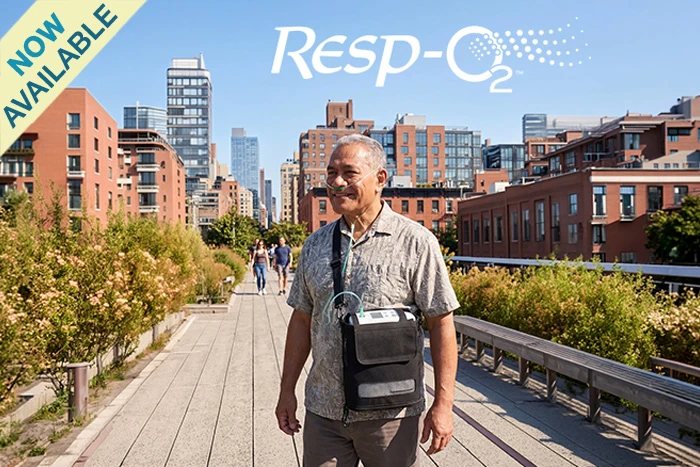
Freedom to move without leaving oxygen behind
Posted by Melissa on 2nd Sep 2026
For people who depend on supplemental oxygen, the hardest part of therapy is often not the oxygen itself—it is being tied to a machine, a tank, or a wall outlet. Dynarex’s newly available Resp-O₂ Portable Oxygen Concentrator (item 33955) is built around that problem: keep therapy reliable, and give the user more of their day back.
The device is a compact, travel-ready concentrator that draws oxygen from room air rather than relying on refillable tanks. According to Dynarex’s launch description, it is designed for 24/7 use, delivers about 90% oxygen concentration, and offers adjustable flow from 1 to 6 liters per minute so therapy can be set to a prescribed need rather than a one-size-fits-all output. At under 5 pounds, it is light enough to take from bedside to car, office, or a short outing without the bulk of a home stationary unit.
What that means in daily life
- Less time waiting on tanks. A concentrator produces oxygen as you use it. For many users, that reduces the cycle of running out, swapping cylinders, and scheduling deliveries—especially useful at home and while moving between rooms or appointments.
- Therapy that can travel with you. FAA-compliant design, a carry bag, AC and DC adapters, and rechargeable battery options (including 8-cell and 16-cell packs in the accessory line) support use in a vehicle, at work, or away from a wall outlet. The point is continuity: oxygen does not have to stop when you leave the living room.
- Settings you can match to activity. Flow from 1–6 LPM lets users (under clinician direction) adjust output for rest versus movement. Pulse-style portable units typically deliver oxygen when a breath is detected, which can stretch battery life compared with running a continuous stream all day.
- Fewer surprises. Visual and audible alarms flag power problems, drops in oxygen purity, and no-breath detection. For someone who cannot afford a silent failure, those alerts are not extras—they are how the device tells you to act before saturation falls.
- Easier to live with. Quiet operation matters if the unit sits beside a bed, at a desk, or in a waiting room. A small footprint also means it is less likely to dominate a room or become something you avoid using because it is inconvenient to move.
Shauna Winston, RRT, RCP, Category Manager at Dynarex, put the user benefit plainly: many oxygen users want to travel, work, and stay active without giving up therapy. This concentrator is aimed at that combination—dependable delivery in a package light enough to carry.
A practical note for oxygen-dependent users
This is still a prescribed medical device. Flow setting, pulse versus continuous need, battery planning for flights or long days, and whether a portable unit can replace a home 5 L or 10 L concentrator at night should be decided with a clinician. Portable units are typically best for users whose prescription and breathing pattern fit pulse-dose delivery; people who need higher continuous flow, especially during sleep, often still keep a stationary concentrator at home.
To purchase or learn more about this portable oxygen concentrator CLICK HERE